

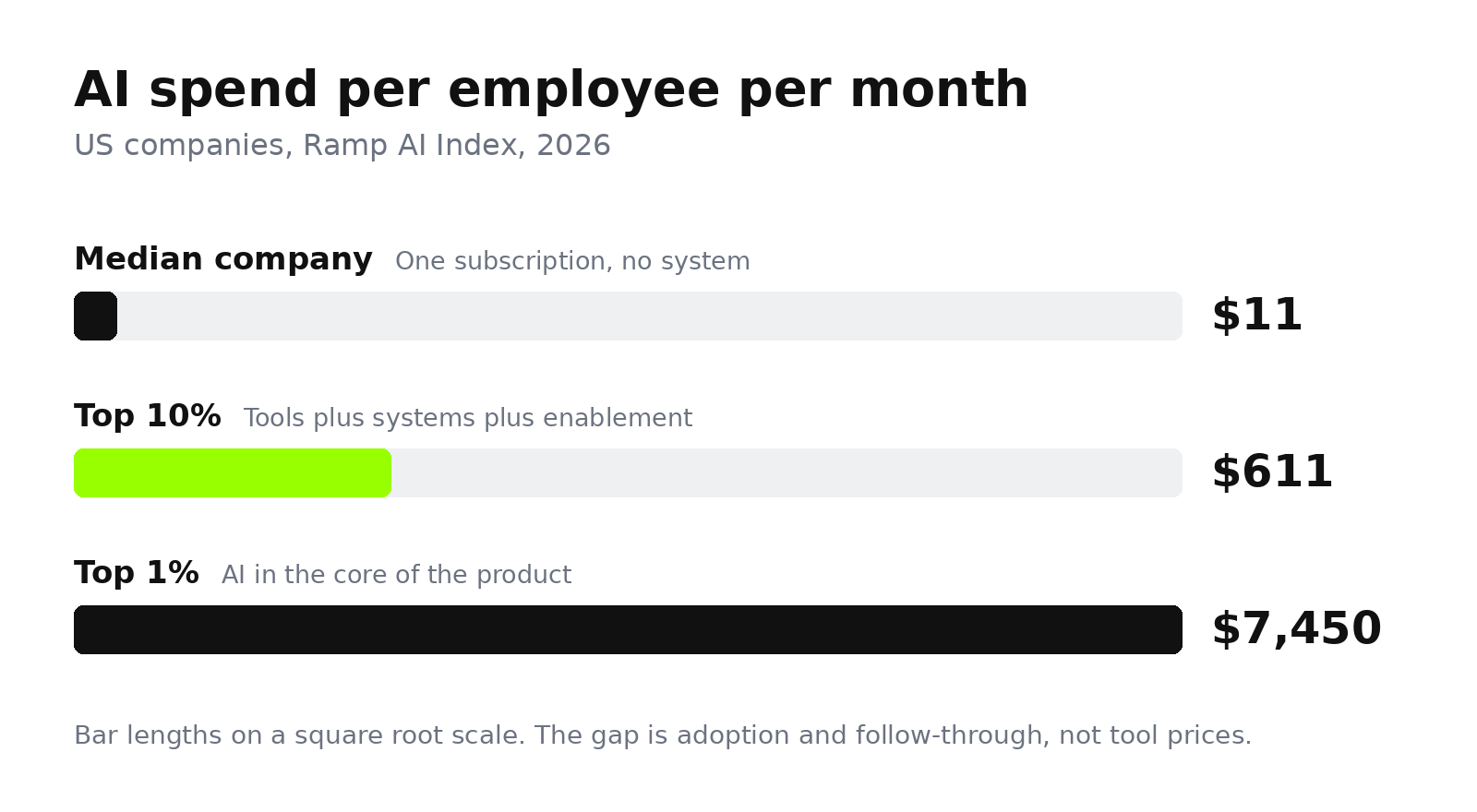
Ramp publishes anonymized spending data from the corporate cards of over 40,000 US businesses, which makes its AI Index one of the few honest windows into what companies actually pay for AI. The current numbers are stark. The median firm spends $11.38 per employee per month. The top 10 percent spend $611. Overall AI spend grew roughly 4x in a single year, and the median AI-spending company now puts close to 15 percent of its software budget into AI.
Eleven dollars is one subscription. It describes a company that bought a license, called it an AI strategy, and stopped. The spending gap in the data is not a gap in ambition or budget. It is a gap in follow-through, and it maps almost perfectly onto the adoption failures the research keeps measuring.
Why the median number fails
A license without a system produces generic output, and generic output does not survive contact with real work. The employee tries it, gets a draft that needs as much fixing as writing, and goes back to the old way. The subscription renews quietly.
This is how companies end up simultaneously spending on AI and getting nothing from it. The money went to seats. None of it went to making the seats worth sitting in.
Where the money should go
BCG's study of AI leaders found they allocate roughly 10 percent of effort to algorithms, 20 percent to technology and data, and 70 percent to people and processes. Translated to a small company budget, that means three buckets.
- Tools. The seats themselves, kept lean and reviewed quarterly
- Systems. Connecting AI to your documents, pricing, tone, and the software you already run
- Enablement. A standing training cadence and a named owner who keeps the setup current
Most 10 to 50 person companies fund the first bucket and skip the other two. The leaders in the data do the opposite. Tools are the smallest line on their AI budget.
A sane shape at this size
For most of our clients the working setup lands on three to five core tools, one system layer grounded in company knowledge, and a fixed monthly slot for training and improvement. The total is a fraction of one salary, which matters, because the alternative benchmark is a $350,000 head of AI most companies this size cannot justify.
Two habits keep the budget honest. Cut seats nobody used last quarter, and never add a tool without deciding what it replaces.
Spend is a trailing indicator
The dollars follow the operation, not the other way around. Companies that treat AI as an owned system end up spending more per employee over time because the spend keeps earning its place. Companies that treat it as a subscription end up at the median, paying eleven dollars for a capability they do not have.
Judge the budget by hours moved, not dollars spent. If you cannot point to where the saved hours went, the number on the card statement is irrelevant.